Baby teeth
A full set has 20 milk teeth: 10 at the top and 10 at the bottom. Most children have them all by around age 3.


Help your teeth stay strong. Brush away the plaque bugs, choose tooth-friendly snacks and make a little time for your smile every day.
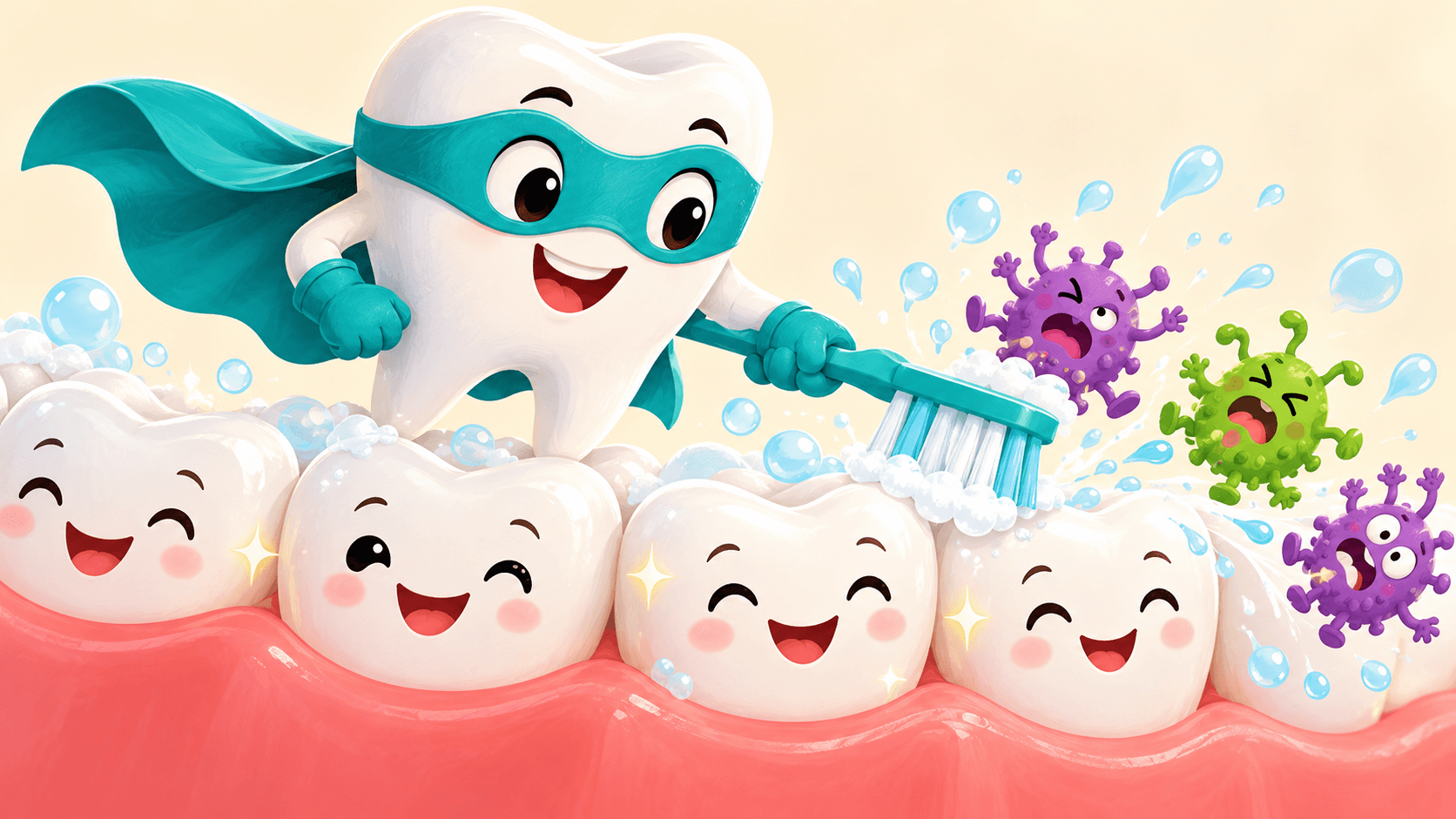
Our cartoon bugs represent the bacteria in plaque.
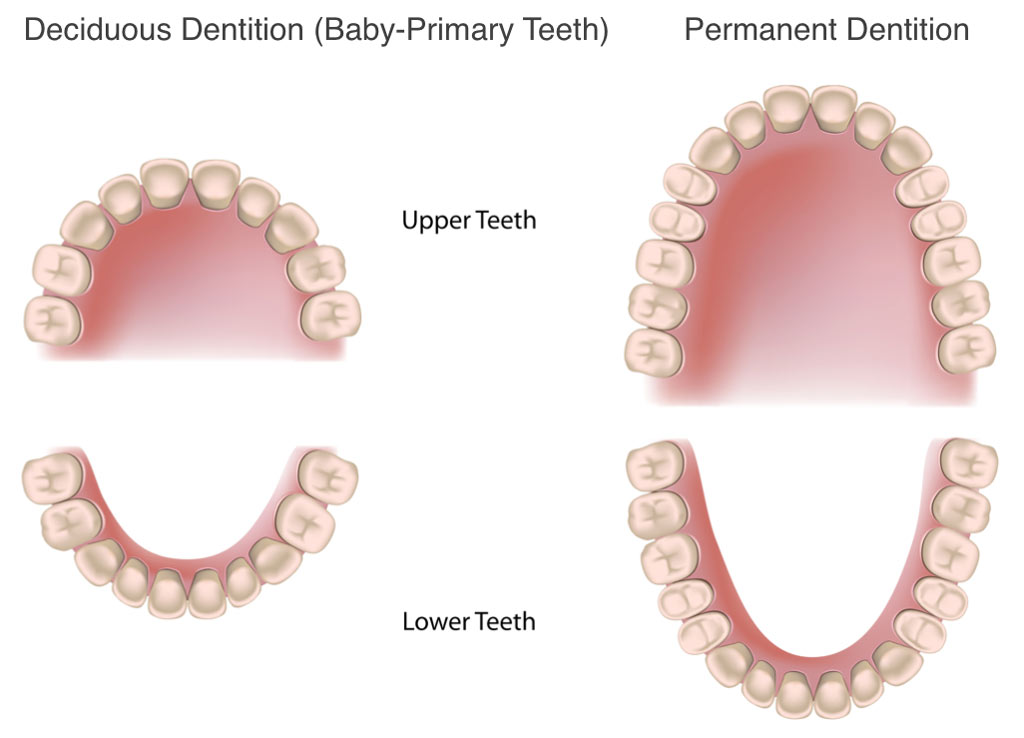
A full set has 20 milk teeth: 10 at the top and 10 at the bottom. Most children have them all by around age 3.
There are 28 adult teeth without wisdom teeth, or up to 32 including four wisdom teeth. Not everyone develops all four.
Adult teeth usually start arriving around age 6. The first adult molars appear behind the baby teeth: they do not replace a baby tooth.
Baby teeth matter. They help children eat and speak, and hold space for the adult teeth. Keep them healthy even though they will eventually fall out.
Book their first dental visit when the first milk tooth appears, or before their first birthday. Come even if no teeth have arrived yet.
A gentle first visit helps your child get used to the practice. We can look at their mouth, answer questions and show you how to care for those tiny teeth.
Keep it positive and relaxed. After that, follow the check-up interval your dentist recommends. Contact us sooner for toothache, swelling or concerns about tooth development.
Arrange a first visit ↗As teeth come through, your baby may have sore red gums, dribble more, chew things or be unsettled. Some babies have very little discomfort.
Do not assume illness is teething. A fever of 38°C or higher or diarrhoea should not be put down to teething. If your baby seems unwell or you are concerned, contact your GP or NHS 111.
These are approximate ages, not deadlines. Teeth can arrive earlier or later, and matching upper and lower teeth do not always appear together.
The first tooth often appears at about 6 months, but some babies start before 4 months and others after 12 months.
| Tooth group | Rough guide |
|---|---|
| Centre front teeth | Around 6 months |
| Side front teeth | Around 8 months |
| First back teeth | Around 12 months |
| Pointed canines | Around 18 months |
| Second back teeth | Around 24 months |
Most children have all 20 baby teeth by age 2–3. Start brushing as soon as the first tooth appears.
Baby teeth usually start getting wobbly around age 6. For a while, children have a mixture of baby and adult teeth.
| Tooth group | Usual age range |
|---|---|
| First adult molars | 6–7 years |
| Front teeth (incisors) | 6–9 years |
| Pointed canines | 9–12 years |
| Premolars | 10–12 years |
| Second adult molars | 11–13 years |
| Wisdom teeth | Often 17–21 years; may be later |
The first adult molars grow behind the baby teeth. They need brushing straight away. Wisdom teeth may never come through, and not everyone develops all four.
NHS: baby tooth development ↗ · NHS England: adult tooth eruption guide ↗
Plaque is a sticky film of bacteria that keeps forming on teeth. It can be hard to see. Careful brushing removes it, especially where teeth meet gums.
Some plaque bacteria turn sugar from food and drinks into acid. Repeated acid attacks weaken the tooth surface and can eventually make a hole called a cavity.
Decay can be painless at first. Toothache, sensitivity or a new white, brown or dark patch should be checked by your dentist.
Plaque can irritate gums, making them red, swollen or bleeding. This early inflammation is called gingivitis and can improve with effective cleaning and dental care.
If your child’s gums bleed or stay sore, contact the practice. Keep cleaning gently rather than stopping brushing.
Plaque bacteria use sugar to make acids that attack teeth. A cavity is a hole that needs your dental team’s care.
Sticky plaque can irritate the gums. Redness, swelling or bleeding means it is time for gentle cleaning and advice from your dentist.
Brush away plaque with your grown-up. Regular effective cleaning helps keep teeth clean and lets inflamed gums recover over time.
These are cartoon examples. Brushing removes plaque; it cannot repair an existing cavity. Ask us to check a painful tooth or bleeding gums.
Make everyday choices that help your teeth, and keep sugary treats occasional and with meals. How often you have sugar matters, as well as how much.
Choose age-appropriate portions and textures, and consider food allergies.
Avoid sipping sugary drinks or grazing on sweet snacks throughout the day. Sugar-free fizzy drinks can still be acidic and damage tooth enamel.
Diet and sugar-free fizzy drinks can still contain acids that soften and wear away the tooth’s enamel. This is called acid erosion.
Acidity varies between products: a sugar-free drink can be just as acidic as a sugary drink, so the sugar-free label does not make it safe for teeth. Removing sugar reduces sugar-related decay risk, but it does not remove the risk of acid damage.
Choose plain water between meals. Keep acidic drinks occasional and with meals; avoid sipping them throughout the day.
Start as soon as the first tooth appears. Brush for about two minutes, last thing before bed and at one other time.
Use a small, soft toothbrush and gentle movements. Clean the outsides, insides, chewing surfaces and gumline. Remember the back teeth.
When your child can spit, encourage them to spit out the extra toothpaste. Do not rinse with water afterwards: leave the fluoride working on the teeth.
Parents and carers should brush young children’s teeth, then help or supervise until at least age 7. Older children may still need help. Ask us about cleaning between teeth when they touch.
Under 3: use only a smear, with at least 1,000ppm fluoride. Your dentist may advise 1,350–1,500ppm for extra protection.
Ages 3–6: use a pea-sized amount, with 1,000–1,500ppm fluoride. Family toothpaste with 1,350–1,500ppm gives greater protection against decay.
Age 7 and over: use toothpaste containing 1,350–1,500ppm fluoride.
Check the fluoride level on the tube or box. Do not let children eat toothpaste or lick it from the tube. Follow any individual advice from your dental team.
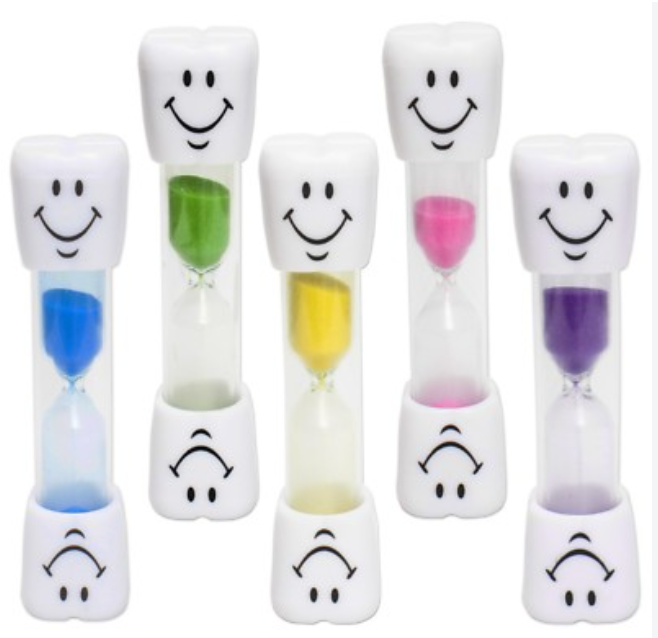
A two-minute sand timer or egg timer helps children see how long to brush. Choose one designed to run for two minutes: ordinary kitchen egg timers may run for longer.
Use it twice a day, including last thing before bed. The timer helps with timing; a grown-up still needs to help children clean every tooth.
Plaque can hide in plain sight. Disclosing tablets colour it so children and grown-ups can see where brushing needs more care.
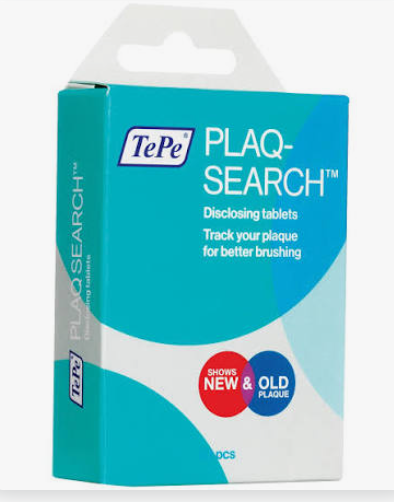
This two-tone tablet helps reveal plaque left after brushing.
Red / pink: newer plaque.
Blue: older plaque, more than 12 hours old.
The stained areas show where to improve cleaning, especially near the gums and between teeth. It is a learning tool, not a score or a reason to feel embarrassed.
Ask us whether it suits your child. They must be able to rinse and spit reliably and follow the instructions. Children under 12 need adult supervision.
Read TePe’s product instructions ↗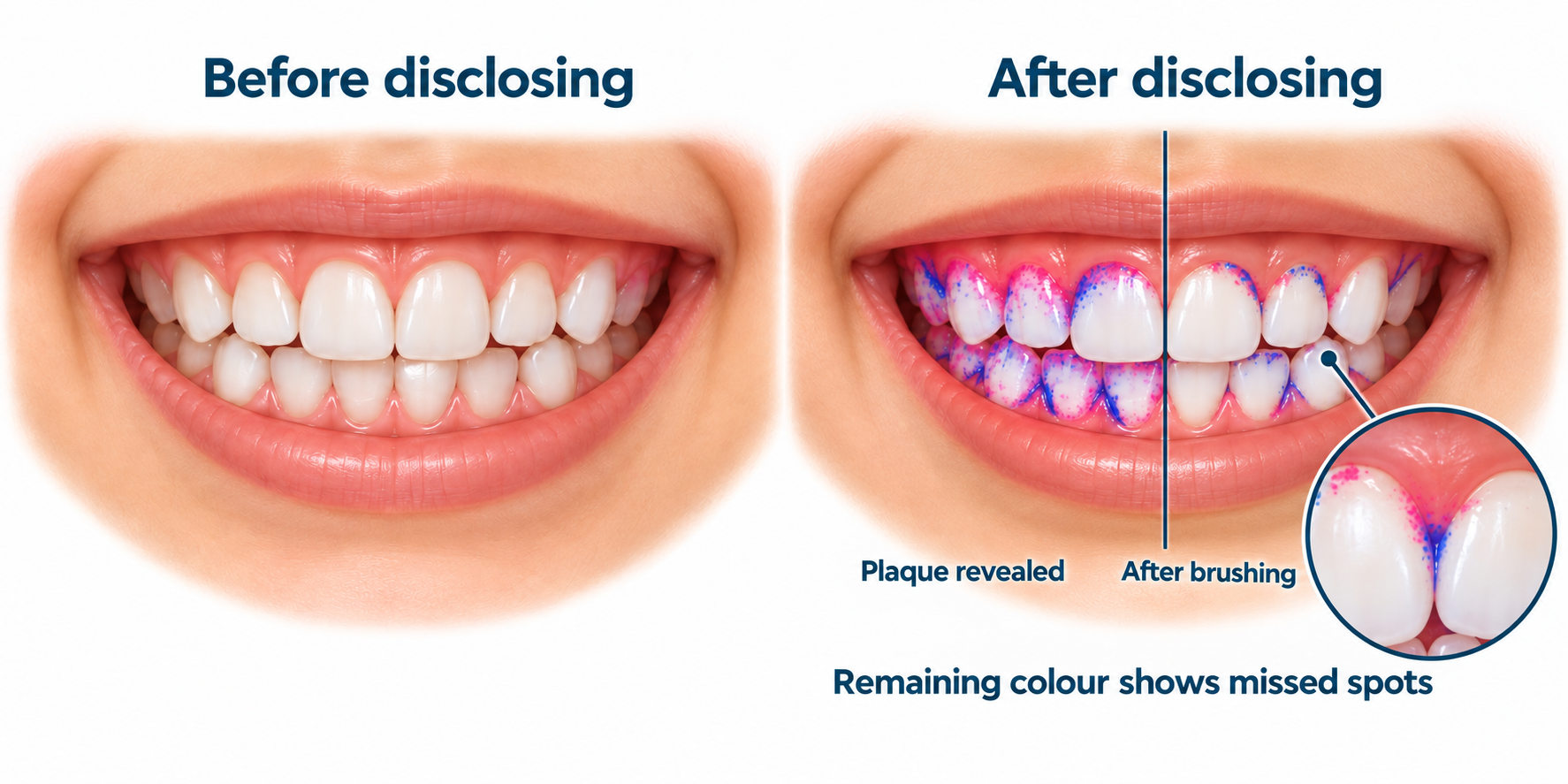
Follow the pack instructions. For PlaqSearch, brush and clean between teeth first, then chew the tablet and rinse away excess dye. Do not swallow it.
Look in a mirror with your grown-up. Spot stained plaque around the gumline, between teeth and on back teeth. Those are the areas to work on.
Gently clean the stained areas again with fluoride toothpaste. After this final brush, spit out the toothpaste without rinsing. Give those spots extra attention next time.
Disclosing dye can temporarily stain the tongue, lips, clothes and sink. Protect surfaces and supervise use. If your child cannot rinse and spit reliably, ask us for another brushing aid.
We build a prevention plan around your child’s age, teeth and risk of decay.
We show children and grown-ups how to clean every tooth, choose the right fluoride toothpaste and reach areas that get missed. Plaque disclosing can make the learning visual.
We help you spot frequent sugar and acid exposures and make practical swaps. Bring your food diary so we can suggest changes that fit your family.
We check teeth, gums, tooth development and the way the teeth bite together. We set the next visit according to your child’s needs and risk.
Dental X-rays can help us find decay between teeth and problems we cannot see directly. We only recommend them when clinically justified, based on the examination and your child’s risk.
A dental professional paints a small amount of concentrated fluoride varnish onto the teeth. It helps strengthen enamel and makes it more resistant to decay.
It can protect baby and adult teeth. From age 3, children should generally be offered it at least twice a year; younger children or those at higher risk may also benefit. We check suitability and explain the aftercare.
Think of a protective raincoat for the deep grooves of back teeth. A thin coating seals these hard-to-clean pits and fissures, helping keep food and bacteria out.
We may recommend them on adult molars as they come through, particularly where grooves are deep or decay risk is higher. We check sealants at later visits and repair or replace them if needed.
These treatments add protection alongside brushing and sensible food choices. Your dentist will explain which options are appropriate for your child.
Thumb or finger sucking is a common comfort habit in young children. If it continues, it can affect the position of the teeth and the way they meet, especially as adult teeth arrive.
Let us know if the habit is continuing or you notice teeth sticking out or a gap when your child bites. We can check their bite and suggest a calm, encouraging plan.
At regular checks we monitor how the teeth and jaws are developing. If we suspect your child may need braces, we will assess their treatment need and discuss an orthodontic referral.
If your child meets the NHS clinical criteria, we will send a referral for an NHS orthodontic assessment before their 18th birthday.
Eligibility is assessed using the Index of Orthodontic Treatment Need (IOTN). Being under 18 alone does not guarantee NHS braces: the orthodontic service confirms eligibility and treatment timing.
Healthy teeth, healthy gums and good brushing are important before and during brace treatment. Tell us about concerns early so there is time to assess and refer appropriately.
Click or tap a document image to download its PDF. All five printables are black and white, with white backgrounds to save ink. Children can add their own colours!
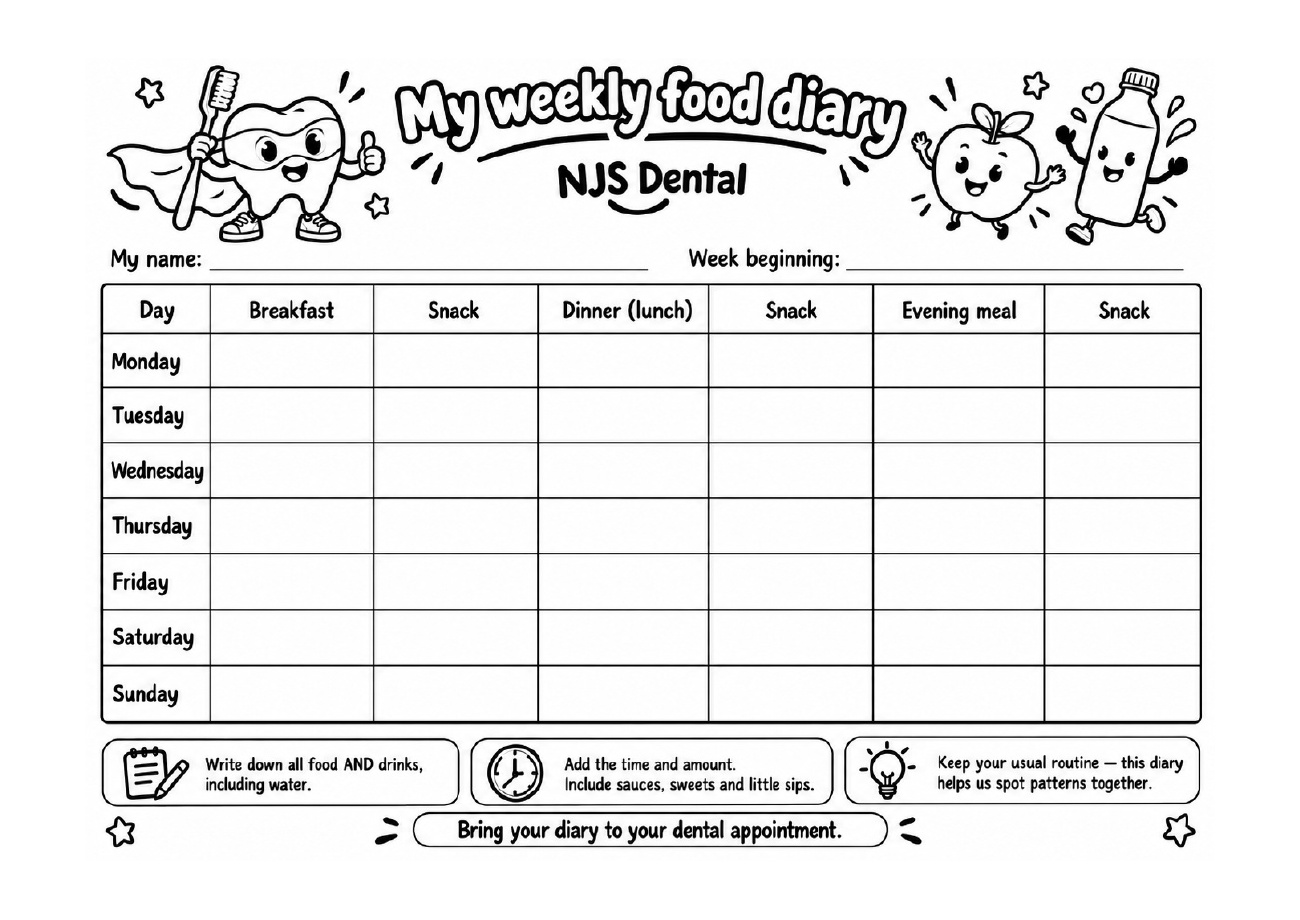 Click or tap to download PDF ↓
A Monday-to-Sunday table for meals, snacks and drinks.
Black and white · A4 landscape · 1 page
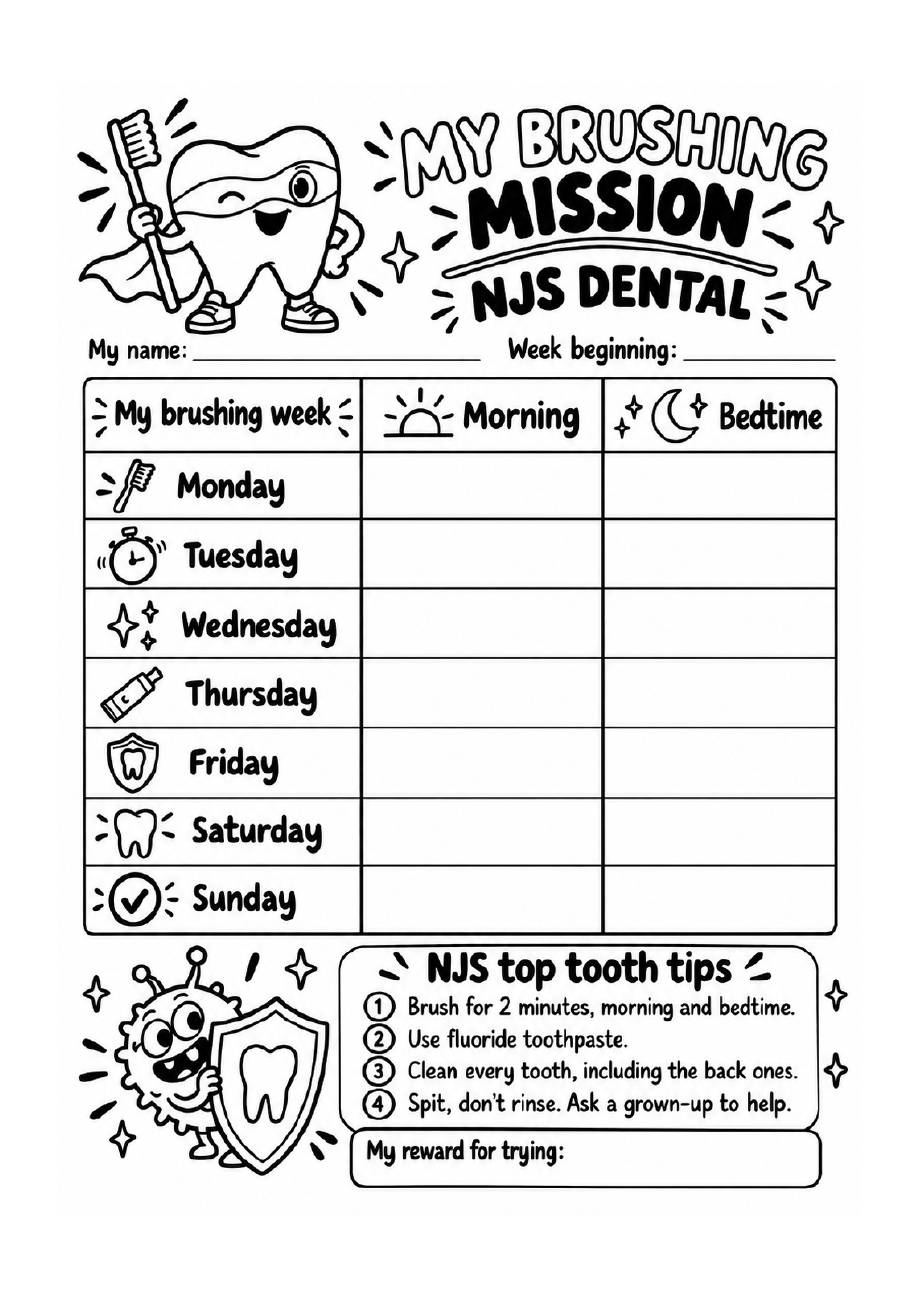 Click or tap to download PDF ↓
Morning and bedtime boxes for ticks or stickers, with brushing tips.
Black and white · A4 portrait · 1 page
Three original colouring activities with simple dental facts. Younger children can explore them with a grown-up.
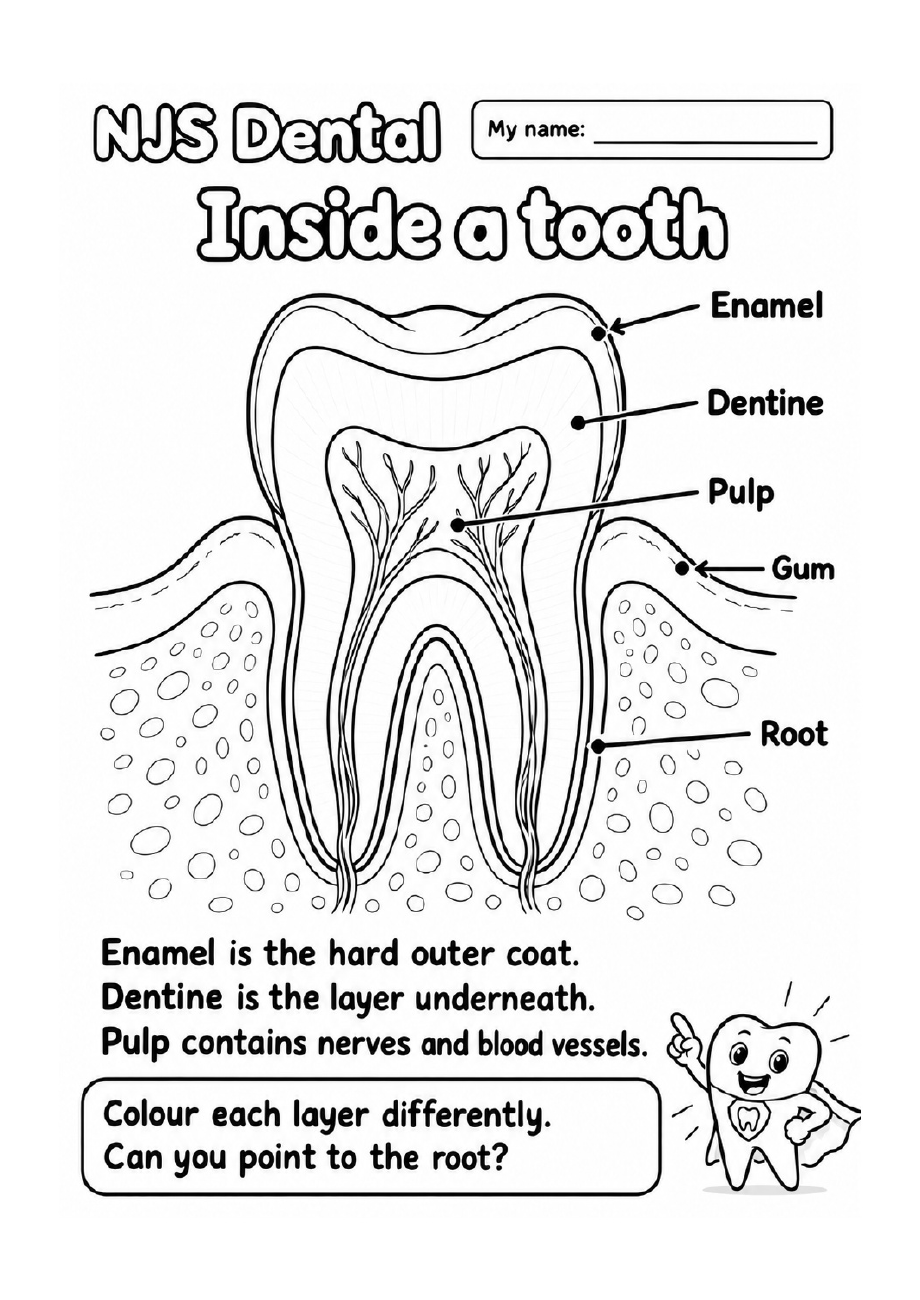 Click or tap to download PDF ↓
Colour the layers and learn what is inside a tooth.
Black and white · A4 portrait · 1 page
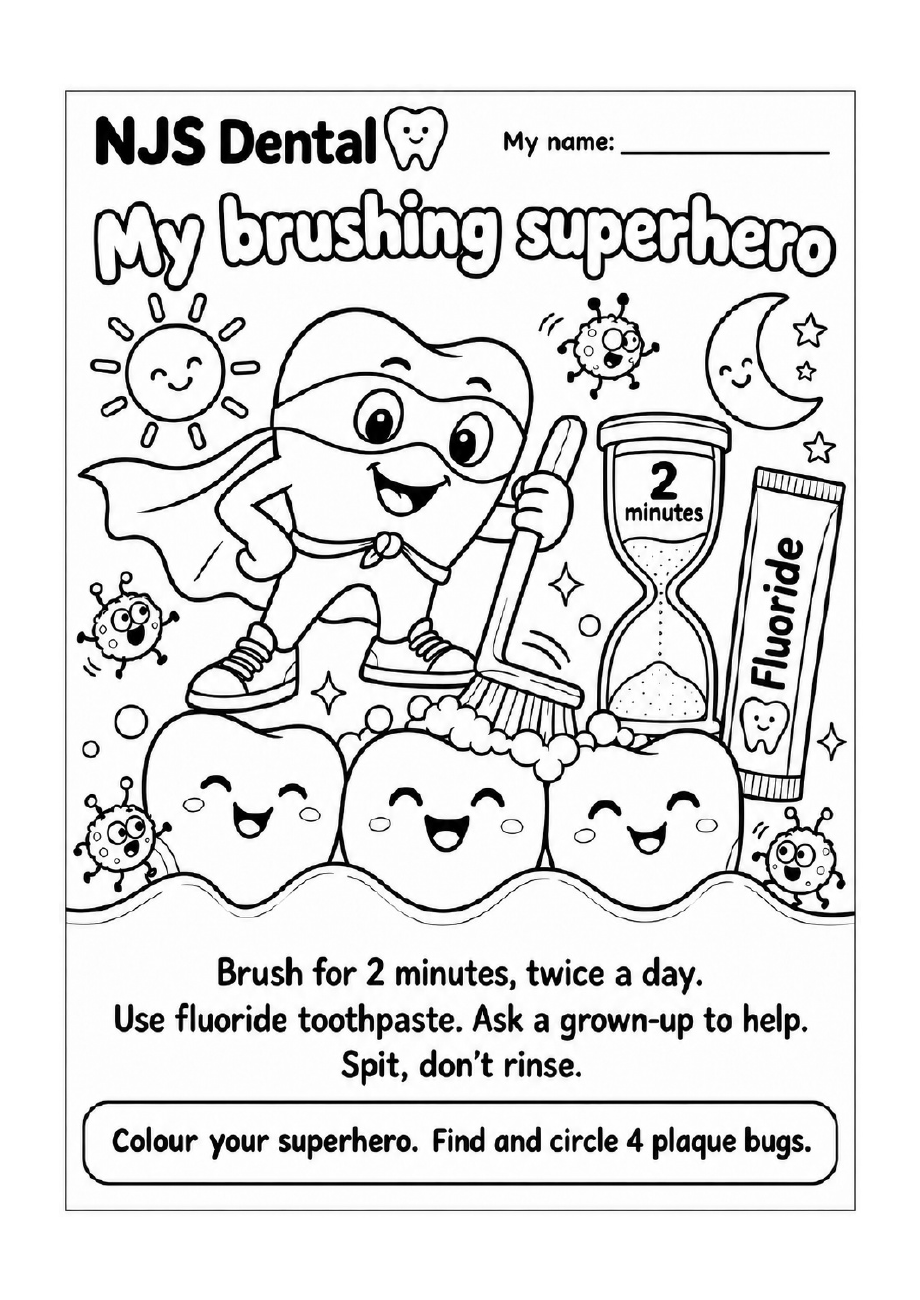 Click or tap to download PDF ↓
Colour the superhero and find the four plaque bugs.
Black and white · A4 portrait · 1 page
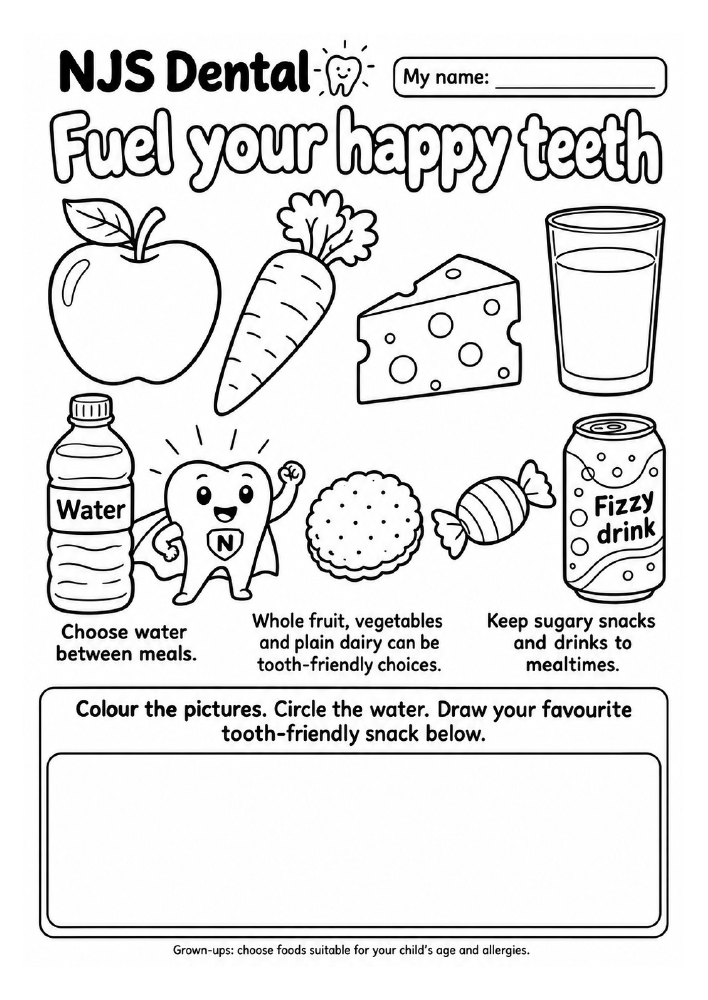 Click or tap to download PDF ↓
Colour, find the water and draw a tooth-friendly snack.
Black and white · A4 portrait · 1 page
Book your child’s first dental visit when their first tooth appears, or before their first birthday. We can check their teeth, demonstrate brushing and discuss fluoride varnish or fissure sealants when appropriate. Follow the review interval your dentist recommends.
If your child has toothache, swollen gums or suspected decay, contact the practice for advice.
Advice for parents and carers. Based on UK prevention guidance, reviewed 10 October 2026. Your child’s dental team can tailor this advice.
NHS: children’s teeth ↗NHS: baby and adult teeth ↗NHS: tooth decay ↗NHS: gum disease ↗NHS: sugar and swaps ↗Delivering better oral health ↗Oral Health Foundation: plaque disclosing ↗NHS Wales: orthodontics ↗NHS: thumb and finger sucking ↗